 Doodlebark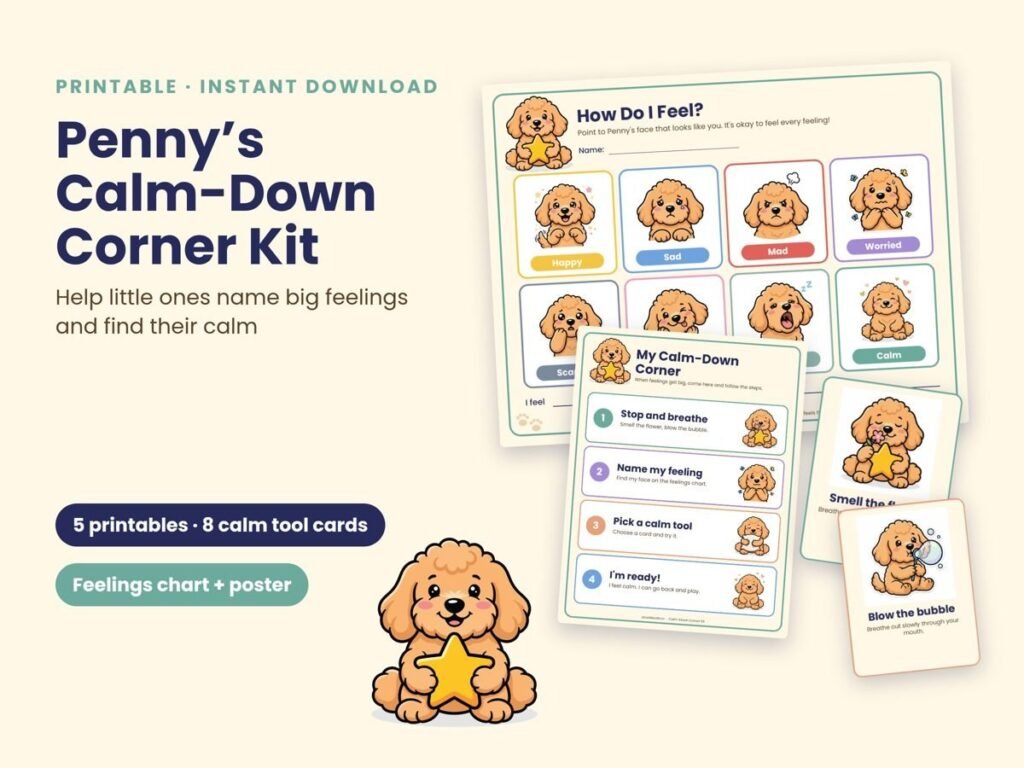
Little kids have big feelings and not a lot of tools for them yet. A calm down corner gives them a place to go and a few simple things to try when a feeling gets too big. It doesn’t need to be fancy. A corner of the living room and a few printables are plenty.
What a calm down corner is (and isn’t)
A calm down corner is not a time-out spot. Nobody gets sent there as a punishment. It’s a cozy place a child can choose to go when they’re mad, sad, worried or wound up. The goal is to help them notice the feeling and calm their body down, so they can think again.
What to put in it
- Something soft. A pillow, a beanbag or a folded blanket.
- A feelings chart. Faces for mad, sad, worried, silly and calm help kids point to what they feel, even before they have the words.
- Calm tool cards. Picture cards for things like taking a deep breath, squeezing a pillow, counting to ten or getting a hug.
- Something for their hands. A stress ball, play dough or a stuffed animal to squeeze.
- A breathing poster. Slow breathing is one of the fastest ways to calm a body down, and kids do better with a picture to follow.
Teach it when everyone is calm
This is the big one. A kid in the middle of a meltdown can’t learn something new. Practice the corner on a good day. Sit in it together, look at the cards, and try the breathing. Make it a game. Then, when a big feeling hits, the corner already feels familiar.
A breathing trick little kids remember
In our Penny Stories, Penny uses one trick over and over: smell the flower, blow the bubble. Breathe in slowly through your nose like you’re smelling a flower. Breathe out slowly through your mouth like you’re blowing a big bubble. Do it three times. It’s simple enough for a two-year-old, and the picture makes it stick.
We even made a short song for it. Kids can sing along while they breathe.
Tips that help it work
- Keep it small. Too many toys and it becomes a play corner.
- Let them choose to go. “Want to go to your calm corner?” works better than “Go to your corner.”
- Go with them at first. Younger kids calm down faster with a grown-up nearby.
- Name the feeling out loud. “You look really mad.” Naming it is half of calming it.
- Praise the trying. “You took three big breaths. That was hard, and you did it.”
Get the printables
Penny’s Calm-Down Corner Kit has everything on this list ready to print: a feelings chart, 8 calm tool cards, a corner poster, a star breathing page and a feelings check-in. See the Calm-Down Corner Kit.
For a story about big angry feelings, read Penny’s Big Mad, where Penny learns to name it, stomp it and breathe it.
Questions parents ask
What age is a calm down corner for?
Most kids can start using one around age 2, with lots of help from a grown-up. Preschoolers and young school-age kids can learn to go there on their own once they’ve practiced it on calm days.
What if my child won’t use the calm down corner?
That’s normal at first. Go with them, sit together and try one tool, like a slow breath. Keep it a cozy spot, never a punishment, and it’ll start to feel safe.
Is a calm down corner the same as a time-out?
No. A time-out is a consequence. A calm down corner is a place a child can choose to go to help their body and feelings settle down.